

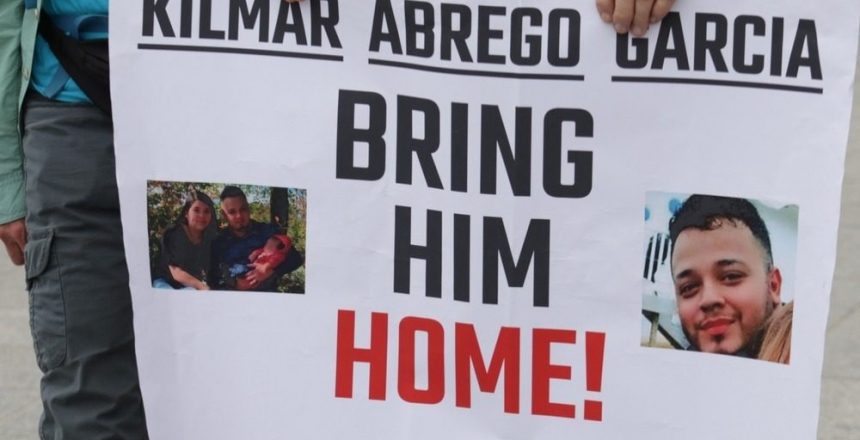
Federal prosecutors have requested that a high-level appellate court reinstate human smuggling charges against Kilmar Abrego Garcia, a Salvadoran national mistakenly deported by the Trump administration last year.
The legal dispute traces back to a November 2022 traffic stop in Tennessee, during which law enforcement officers observed Abrego Garcia transporting nine passengers. Although highway patrol officers initially discussed suspicions of human smuggling, he was let go with a warning. Federal officials later deported Abrego Garcia to El Salvador in March 2025 despite a prior judicial order barring his removal, only to bring him back to the United States three months later after obtaining the criminal indictment.
The filing with the U.S. Court of Appeals for the 6th Circuit seeks to overturn a May ruling by U.S. District Judge Waverly Crenshaw, who threw out the indictment after determining the prosecution was retaliatory in nature. Crenshaw had concluded that federal officials pursued criminal proceedings only after Abrego Garcia successfully contested his unlawful deportation to El Salvador. The 6th Circuit Court of Appeals will now evaluate whether to uphold the lower court’s dismissal or permit the Justice Department to resume its prosecution.
In the formal appeal, the Department of Justice strongly rejected the finding of prosecutorial bias, asserting that federal authorities possessed well-founded, independent justifications to proceed with the indictment. The agency maintained, “The decision to seek an indictment against Abrego Garcia for human smuggling was made by career prosecutors based on the evidence, the law, and their firm belief that there is proof beyond a reasonable doubt that Abrego Garcia had committed the offenses charged.” Government attorneys further argued that the lower court’s decision “marks a dramatic expansion of the power of courts to dismiss serious criminal charges based on subjective assessments of a prosecutor’s motivations” and represents an “unwarranted intrusion into the executive’s powers and responsibility to protect the public.”
Defense attorneys representing Abrego Garcia immediately criticized the government’s appellate filing, calling the Department of Justice’s position “flat wrong” and asserting that “the indictment and prosecution of Abrego Garcia was, in fact, vindictive; the evidence before the district court established just that; and the proof was clear notwithstanding the DOJ’s refusal to call the actual decision makers” to testify under oath. Defense representatives added that “this case was initiated vindictively and on instructions from the White House after our client successfully won his Supreme Court case” to secure his return to the United States.
Editorial credit: nmoyPhoto / Shutterstock.com