

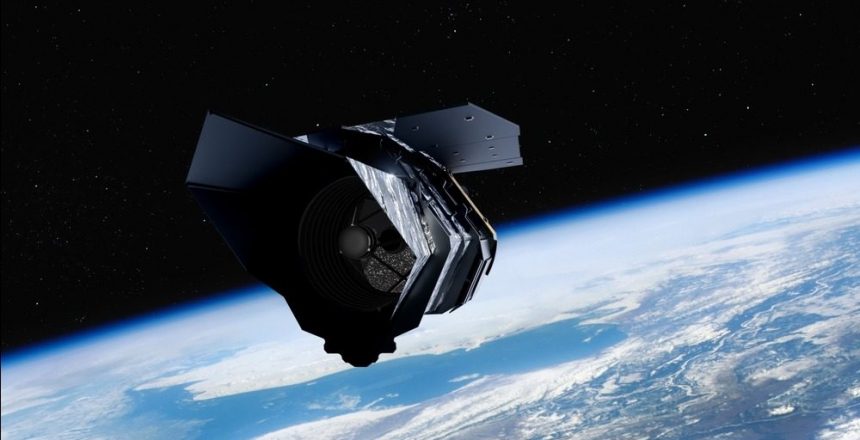
NASA launched its next-generation Nancy Grace Roman Space Telescope Sunday, sending the $4.3 billion observatory into space aboard a SpaceX Falcon Heavy rocket to investigate some of the universe’s biggest mysteries. Named for Nancy Grace Roman, NASA’s first chief astronomer and a key figure in the development of the Hubble Space Telescope, the observatory is expected to provide a sweeping new view of cosmic history. Scientists hope its enormous surveys will reveal previously unseen objects and help answer fundamental questions about why the universe is expanding at an accelerating rate, how galaxies formed and evolved, and how planetary systems are distributed throughout the Milky Way.
The rocket lifted off at 7:26 a.m. EDT from Launch Complex 39A at NASA’s Kennedy Space Center, beginning Roman’s roughly three-month journey to an orbit around the sun near the second Sun-Earth Lagrange point, about 1 million miles from Earth. Roman is designed to complement NASA’s Hubble and James Webb space telescopes by combining a wide field of view with high-resolution infrared observations. Its field of view is at least 100 times wider than Hubble’s, allowing it to survey enormous sections of the sky and help scientists map billions of galaxies, investigate dark matter and dark energy, examine black holes and identify planets beyond the solar system. NASA says Roman will survey the universe roughly 1,000 times faster than Hubble.
The telescope also carries a coronagraph developed to demonstrate technology for directly imaging planets orbiting other stars. While Roman is not specifically designed to determine whether those worlds harbor life, its observations could help lay the groundwork for future missions seeking potentially habitable planets. Its primary 300-megapixel Wide Field Instrument will generate about 1.4 terabytes of data each day, which scientists and other researchers will use for a broad range of astronomical studies.
The spacecraft successfully separated from the Falcon Heavy’s second stage about 31 minutes after liftoff, and NASA controllers began receiving telemetry seven minutes into the flight. Roman’s solar panels and lower instrument sun shade were subsequently deployed as planned. The mission is expected to operate for at least five years, with the possibility of an extension, and NASA anticipates releasing its first images in early 2027 after the spacecraft completes its deployment, calibration and testing phase.
Editorial credit: Elliptic Studio / Shutterstock.com