

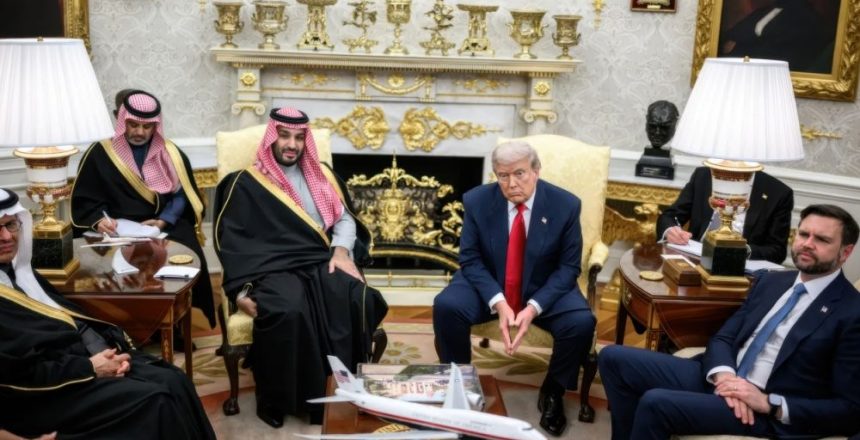
President Trump has approved a landmark 30-year civil nuclear cooperation agreement with Saudi Arabia, establishing a legal framework for American firms to build the kingdom’s civilian nuclear infrastructure. The pact, structured under Section 123 of the Atomic Energy Act, aims to deepen strategic ties, unlock billions in economic potential for the U.S. nuclear industry, and block strategic competitors such as Russia and China from dominating the region’s energy market.
Under Crown Prince Mohammed bin Salman’s Vision 2030 economic diversification initiative, Saudi Arabia seeks civilian nuclear power to reduce its reliance on fossil fuels for domestic energy generation. Expanding nuclear power will assist in fulfilling rising energy demand driven by desalination, cooling systems, and expanding artificial intelligence data centers. Generating atomic power is expected to free up around 1.4 million barrels of crude oil that the kingdom currently burns each day for electricity, preserving those natural resources for international export.
A key element of the arrangement outlines a joint U.S.-Saudi feasibility study to determine whether a commercial uranium enrichment plant should be constructed on Saudi soil. If the project proceeds, operating authority would be maintained through corporate entity contracts rather than independent host-country control. While the framework provides a legal structure for joint fuel cycle activities, administration sources note it does not mandate an immediate transfer of sensitive technology.
The proposal has drawn swift opposition from non-proliferation experts and Capitol Hill lawmakers who express concern over regional security risks. Unlike the 2009 “gold standard” agreement signed with the United Arab Emirates, this agreement does not explicitly require Saudi Arabia to forgo domestic enrichment or spent fuel reprocessing. Additionally, the agreement does not mandate adoption of the International Atomic Energy Agency’s Additional Protocol, an oversight mechanism that grants inspectors the ability to perform snap audits at undeclared sites.
The Trump administration plans to formally submit the agreement to Congress for review in the coming days. Supporters maintain that anchoring the deal with American technology gives Washington continuous oversight and influence over Riyadh’s atomic progress. Meanwhile, lawmakers are expected to question administration officials extensively regarding the strategic and non-proliferation consequences for the broader Middle East.Does Trump’s Saudi Deal Bring Riyadh Closer To Nuclear Capability?This news report provides expert commentary and context regarding the security implications, uranium enrichment details, and global reaction surrounding the U.S.-Saudi civil nuclear agreement.
Editorial credit: Robert V Schwemmer / Shutterstock.com