

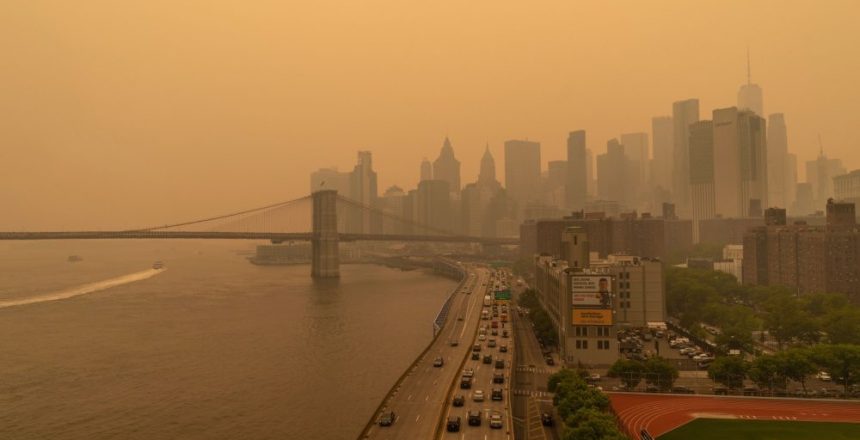
Thick smoke emanating from hundreds of active wildfires across Canada and northern Minnesota has blanketed a large portion of the United States, triggering hazardous air quality warnings across the Midwest and Northeast. A lingering high-pressure weather system has trapped fine particulate pollution close to the ground, casting an orange and yellow haze over major metropolitan areas and dropping visibility to less than a half-mile in heavily impacted zones. Environmental agencies issued widespread alerts stretching from the Great Lakes region to the Atlantic coast, urging millions of residents to stay indoors as municipal air pollution indexes soared to historically dangerous levels.
Major urban centers recorded some of the worst atmospheric pollution globally, with Detroit, Toronto, Chicago, and Minneapolis topping international real-time pollution trackers. In Michigan and Minnesota, weather officials warned that the atmospheric stagnation could keep the smoke locked in place for days, if not weeks. Local infrastructure felt the immediate strain as municipal governments shifted school activities indoors, opened cooling centers, and distributed tens of thousands of specialized particle-filtering face masks at major transit hubs.
Public health officials emphasize that microscopic smoke particulates are capable of entering the bloodstream and deeply lodging in human lungs, exacerbating cardiovascular and respiratory illnesses. The severe conditions prompted Philadelphia Health Commissioner Dr. Palak Raval-Nelson to warn residents that “Today is not the day to start your marathon training plan,” while weather experts noted that relief hinges entirely on shifting upper-level winds and incoming weekend rainfall.
For many in the affected regions, the immediate sensory impact was impossible to ignore; downtown Chicago residents have mentioned the smell, noting “when you wake up in the morning, you can smell the air,” while St. Paul, Minnesota, residents observed that the sky appeared to be “glowing yellow,” due to the heavy aerial dense plume.
Editorial credit: lev radin / Shutterstock.com