

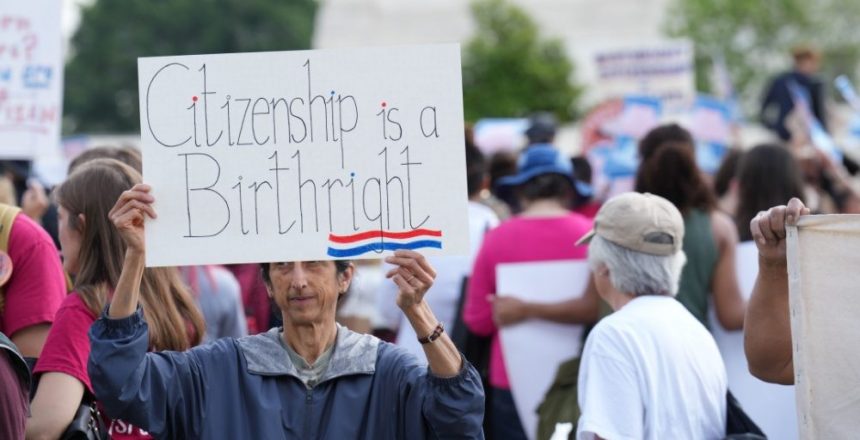
The U.S. Supreme Court on Tuesday rejected President Donald Trump’s effort to restrict birthright citizenship, ruling that his executive order cannot override the Constitution’s longstanding guarantee that nearly everyone born on American soil is a U.S. citizen.
Trump’s order, signed on the first day of his second term, sought to deny automatic citizenship to children born in the United States if their parents were undocumented immigrants or were in the country on temporary visas. Federal courts had blocked the policy before it could take effect, and the Supreme Court’s decision leaves those injunctions in place. Legal analysts said the ruling reinforces that a president cannot alter constitutional protections through executive action alone and that any fundamental change to birthright citizenship would require a constitutional amendment or other action consistent with constitutional requirements.
In a 6-3 decision, the high court upheld a nearly 160-year-old constitutional precedent, ruling that the administration’s policy violated the Citizenship Clause of the 14th Amendment. The court concluded that the 14th Amendment’s Citizenship Clause protects children born in the United States regardless of whether their parents are in the country illegally or temporarily, delivering a significant setback to one of the administration’s signature immigration initiatives.
Chief Justice John Roberts, authoring the majority opinion, explicitly rejected the administration’s narrow interpretation of constitutional authority. Roberts was joined by the court’s three liberal justices, as well as conservative Justice Amy Coney Barrett, while Justice Brett Kavanaugh concurred with the judgment on statutory grounds. In the decision, Roberts wrote that “[c]hildren born in the United States to parents unlawfully or temporarily present are ‘subject to the jurisdiction’ of the United States and are citizens at birth under the Fourteenth Amendment’s Citizenship Clause.”
Justices Clarence Thomas, Samuel Alito and Neil Gorsuch dissented from the majority, with Thomas penning a lengthier counter-argument, asserting that the court had misinterpreted the historical intent of post-Civil War protections. Thomas argued that the court took an extraordinary and improper step by “holding facially unconstitutional the President’s Order excluding from citizenship the children of foreign temporary visitors and illegal aliens.” He added that the ruling “adds to the sad history of the Fourteenth Amendment, which was designed and understood to secure equal rights for the freed blacks but has instead been repurposed for political projects that the Reconstruction Congress did not support.”
The Trump administration had argued that children born to certain noncitizens were not “subject to the jurisdiction” of the United States as required by the 14th Amendment. The majority rejected that interpretation, finding it inconsistent with the Constitution’s text, historical understanding and decades of judicial precedent. Immigration advocates praised the decision as preserving an established constitutional right, while Trump criticized the ruling and urged Congress to pursue legislative changes. Researchers have estimated that the executive order would have affected more than 250,000 babies born in the United States each year had it been allowed to take effect.
Editorial credit: Phil Pasquini / Shutterstock.com